
Sage100 Integration Overview & Requirements
Share real-time data about your assets and sites to your ERP for total visibility over operations and their associated costs. Sage100 currently only supports multi-companies for accounting functions (AP/AR/GL), not equipment and jobs, thus a single database instance in Sage100 feeds the singe Tenna instance. Your team can make informed decisions with accurate data and customize options to fit your business model.
💥Integrations is a premium product and requires a separate license. Please contact your Account Manager for more information on premium product licenses or reach out to Customer Support at help@tenna.com or call 888.836.6269.
In this article:
Data Flow
Enhance your ERP with Tenna’s integration with Sage100™ to eliminate duplicate data entry and improve visibility.
Enter Equipment Once
Enter a new piece of equipment in Sage100™ and it will automatically show up in Tenna or allow the field to enter a pending piece of equipment in Tenna and it will show up in Sage100™. You choose the best process to work for your team.

Enter Jobs Once
Every job set up in Sage100™ can automatically be added to Tenna. You can choose job status or utilize your own unique data field “Send to Tenna”. You choose the best solution for you.

View Utilization Updates Always
Capture hour and mileage readings for your assets and automatically update them from the machine into Sage100™ from Tenna.

Benefits of Integration
- Field Productivity: Alert a project team when a piece of equipment arrives at a jobsite or when it is left behind.
- Accurate Job Costs: View up-to-date equipment listings to code equipment hours more easily and accurately.
- Visibility over Equipment Costs: Analyze and review equipment cost more accurately.
- Collaboration and Efficiency: Keep your office, shop and field teams connected sharing the same data. Eliminate static spreadsheets with efficient data sharing.
- Accountability: Increase accountability among field teams when using or handling assets to help control costs.
- Decision Making: Make educated decisions by taking appropriate action when assets are under (or over) utilized.
Partnership with Data Xchange
Tenna partners with Data Xchange to process transactions, ensuring your Sage100 system’s integrity and security. Data Xchange will install an agent on your server that will connect to your Sage100 system. Every 30 minutes, Data Xchange pulls data from your Sage100 system and reviews for any changes. If there are changes, Data Xchange triggers transactions to process the update into Tenna. Changes in Tenna are sent to Data Xchange in real time and processed to sync with Sage100.

New Assets in Tenna
New equipment or assets are entered in Tenna and automatically updated to Sage100. Our team will help streamline the initial seeding in Tenna with your existing Sage100 equipment.
Initial Asset Load
The Tenna-to-Sage100 integration allows for the initial seeding of assets to match what is already in your Sage100 system, thus ensuring a true synchronization from day one. This process involves steps that will validate accuracy and conformity before the data is loaded into Tenna.
The following steps must be taken prior to the Initial Asset Load:
- 1
- The Data Xchange agent is installed and connected to Sage100 by Data Xchange in collaboration with the customer.
- 2
- The below Integration Setup Instructions are completed.
Once those items are completed, the following will occur:
- 1
- The Tenna Integrations team will perform an intial Sage100 cache load and review the assets as they are stored in Sage100.
- 2
- Validation steps are taken to check for any data that may cause issues in the Tenna platform.
- 3
- A review is set up with the Sage100 point of contact to go over any potential issues found and make corrections if needed.
- 4
- A sample of assets will be chosen and loaded into Tenna.
- 5
- Customer and Tenna will jointly review the assets in Tenna and agree on results or make changes.
- 6
- After the validation is completed, all assets selected to load into Tenna (Sage100 equipment with the status of "1") will be released to populate Tenna assets.
- 7
- You will need to edit the assets in Tenna to add the correct category (all assets will come over with a category of "New from Sage100"), organization, and bill type. This step can be performed through a bulk edit if desired.
New Jobs in Sage100
New jobs or sites need to be entered in Sage100 and they will flow into Tenna. All jobs in Sage100 need to have a unique physical address so that Tenna can create the default geofence based on the Google geo coordinates of the address.
Initial Jobs Load
The Sage100-to-Tenna integration allows for the initial seeding of jobs to match what is already in your Sage100 system, thus ensuring a true synchronization from day one. This process involves steps that will validate accuracy and conformity before the data is loaded into Tenna.
The following steps must be taken prior to the Initial Asset Load:
- 1
- The Data Xchange agent is installed and connected to Sage100.
- 2
- The below Integration Setup Instructions are completed.
Once those items are completed, the following will occur:
- 1
- The Tenna Integrations team will perform an intial Sage100 cache load and review the jobs as they are stored in Sage100.
- 2
- Validation steps are taken to check for any data that may cause issues in the Tenna platform.
- 3
- A review is set up with the Sage100 point of contact to go over any potential issues found and make corrections if needed.
- 4
- A sample of jobs will be chosen and loaded into Tenna.
- 5
- Customer and Tenna will jointly review the sites in Tenna and agree on results or make changes.
- 6
- After the validation is completed, all jobs selected to load into Tenna sites (Sage100 equipment with the status of "4" or "In Progress") will be released to populate Tenna sites.
- 7
- Each new site in Tenna will render a default geofence which you will need to edit to match the actual job site. Each job in Sage100 needs to have a physical address in the record to render the default geofence with the address being the center point of the geofence.
Integration Setup Instructions
The following actions must be taken within Sage100 and Tenna to prepare for the integration to be activated.
Pre-Validation Steps
- 1
- The Asset-to-Tracker Match file is completed or updated with accurate asset information that matches Sage100.
- 2
- Provide extract of jobs from JC from Sage100. Tenna to validate extracts.
Data Xchange Setup Steps
- 1
- Send the following data to the Tenna Integration team to complete the Data Xchange onboarding request.
- Is the customer's Sage100 on-prem or cloud based?
- Who is the customer's primary contact for Sage100 knowledge? Please include email and phone number.
- Is there a primary IT person who would assist in the installation of the Data Xchange agent? If so, please provide email and phone number.
- 2
- Tenna to complete the Data Xchange onboarding form.
- 3
- Customer to acknowledge they have reviewed this Overview & Requirements article.
Tenna Setup Requirements for Sage100
- 1
- Create a new category named "New from Sage100" in Tenna with Type "Equipment". This is case sensitive.
See How to Create and Edit Categories for more information.
Field Mappings
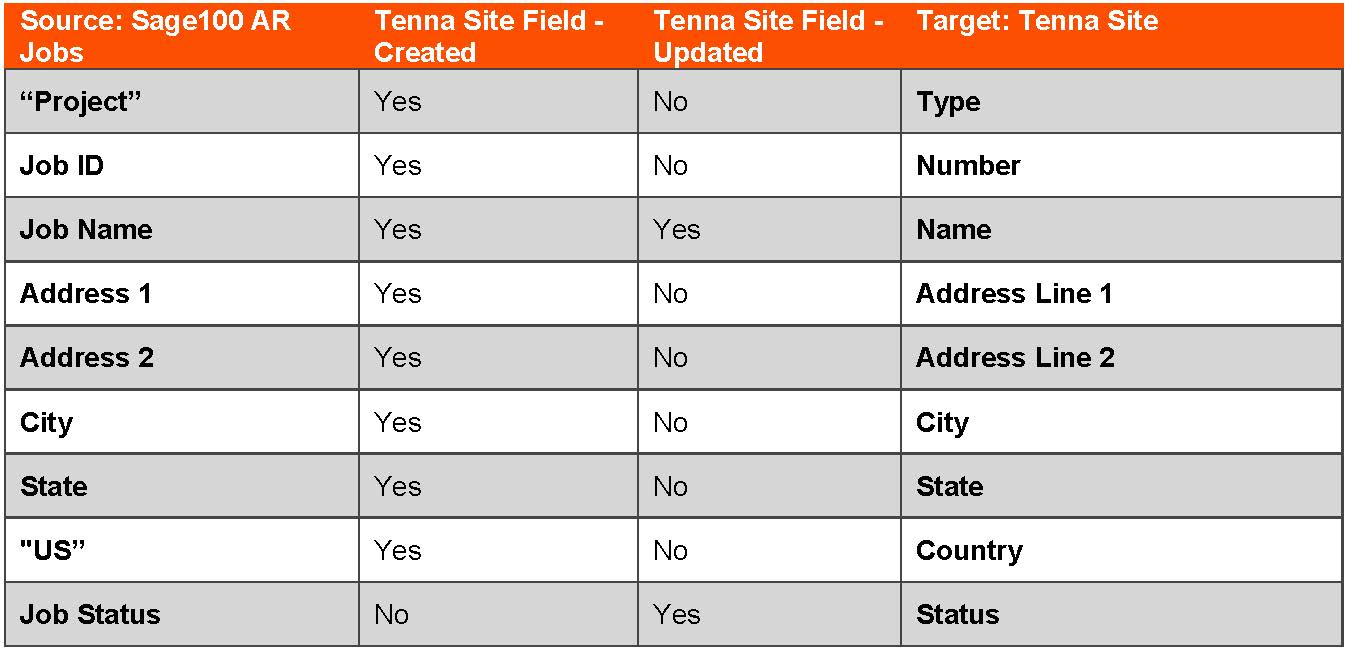
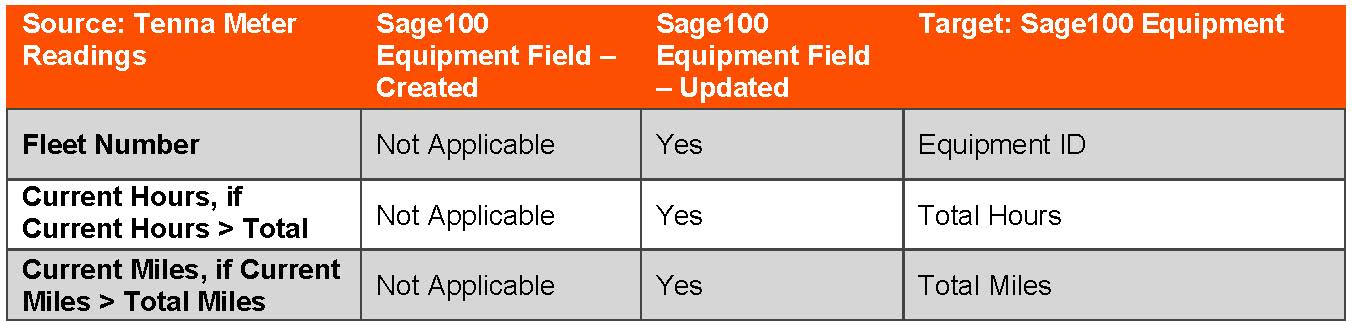
IMPORTANT! Any information from Sage100 will overwrite the existing information in Tenna for the fields in the Field Mapping tables below.
Data Mapping for Sage100 Equipment to Tenna Assets
Equipment records will be created in Sage100 when Assets are created in Tenna when the following is true:
- The fleet number in Tenna does not exist as an Equipment ID in Sage100
- Sage100 Status = “1”
- Category type is one of: “equipment”, “vehicle”, “truck”, or “attachment”
- All assets will be created with designation of “Owned” in Tenna
- Frequency: every 30 minutes
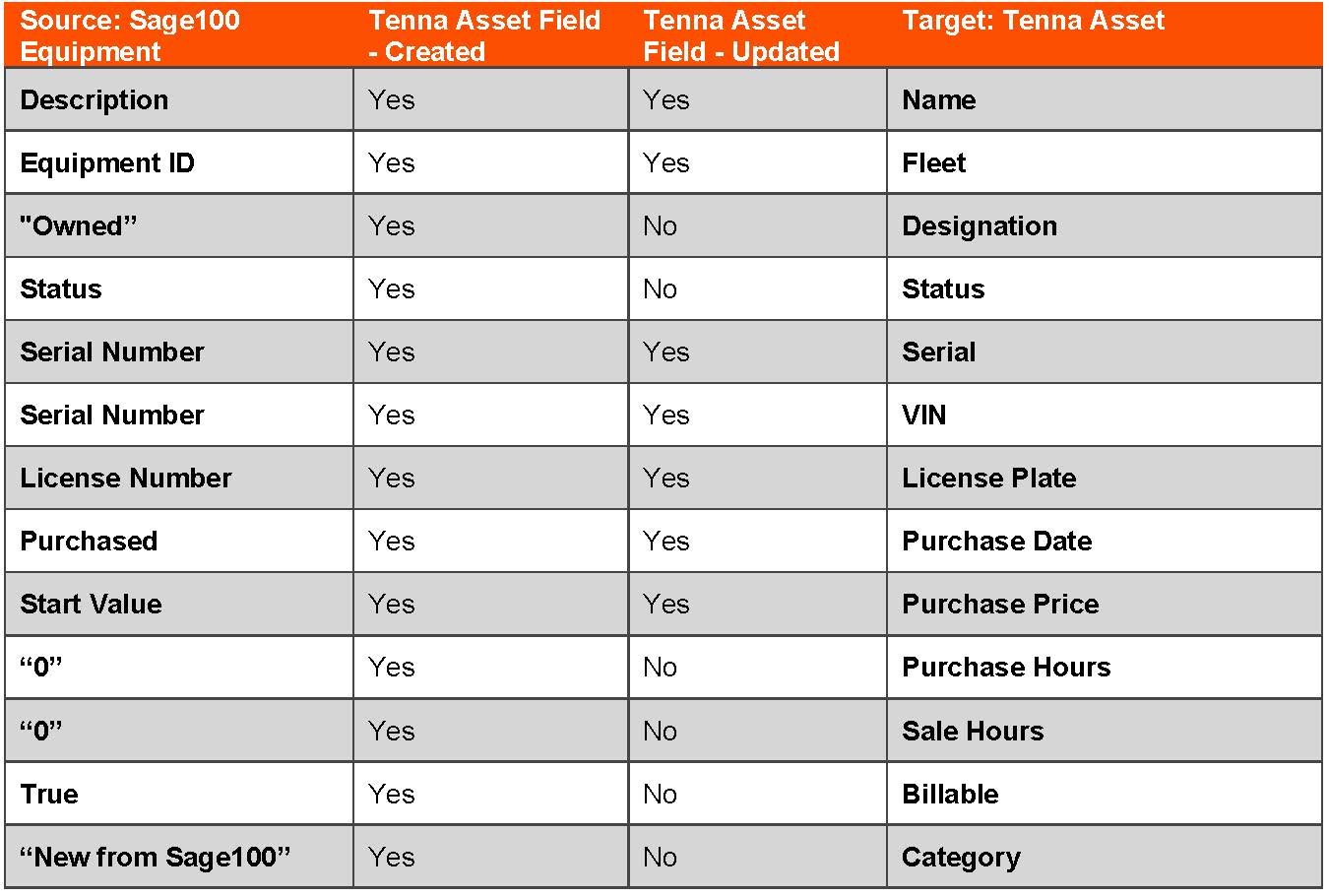
Data Mapping for Sage100 Jobs to Tenna Sites
Sage100 AR Job records will be added to Tenna Sites when the following is true:
- Equipment Status = 4 (Current)
- Frequency: every 30 minutes
Data Mapping for Tenna Meter Readings to Sage100
- Frequency: Once daily at 11:01pm local time
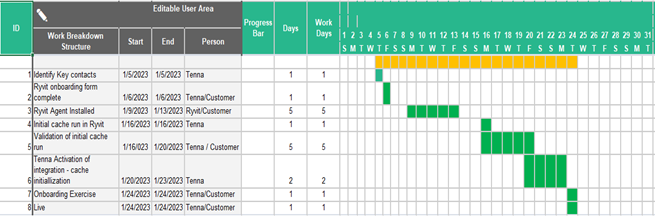
Expected Implementation Timeline
The timeline is an average of 10-20 days beyond kickoff. The following example assumes the activity starts the first of January 2023 and extends for 17 days.
NOTE: For questions, reach out to the Tenna Integrations Department integrations@tenna.com.